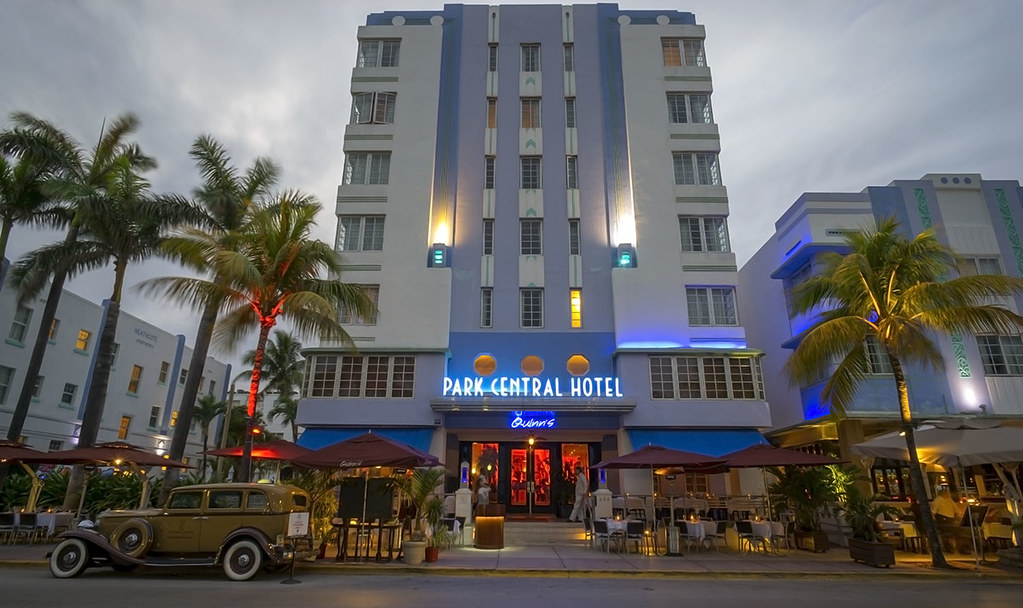
Park Central Hotel
See this geometric terrazzo floor in the lobby of the Park Central Hotel? the one with the sharp angles and contrasting colors? That's not marble. It's cement mixed with stone chips, poured wet, ground down, and polished until it shines. In the 1930s, terrazzo was what you used when you couldn't afford the real thing. It was the knockoff. The budget hack. The contractor's shortcut.
Except it turned out terrazzo was better than marble for a subtropical beach climate. It stays cool underfoot when humidity turns the air into soup. It resists moisture damage. It doesn't crack when temperatures swing. And it costs a fraction of the price. So Hohauser used it everywhere. What started as a cost-cutting measure became a signature. Sometimes you get lucky and your compromise becomes your style.
Now look up. See those eyebrow overhangs above the windows? They're not decorative. Before air conditioning, you needed shade. Those concrete ledges block direct sun, channel rainwater away from the facade, and cut cooling costs. Form following function, disguised as ornament. Everything in this building that looks like style started as survival.
That blue neon marquee, the one they call "the Blue Jewel," has been photographed more times than most celebrities. But on New Year's Eve 1940, something actually interesting happened here. Desi Arnaz, playing the Park Central's nightclub, led America's first conga line through this lobby. Tourists joined in. The line snaked out onto Ocean Drive. It made the newspapers. A Cuban bandleader teaching Depression-era Americans to shake their hips in a Jewish-owned hotel that advertised itself as "restricted" five years earlier. The irony was apparently lost on everyone having fun.
Clark Gable stayed here. Rita Hayworth stayed here. Then, like every other building on this strip, the Park Central declined into cheap housing for elderly retirees in the 1960s and 1970s. The Blue Jewel went dark. The terrazzo got covered in grime. The eyebrows shaded people who had nowhere else to go and not much money to spend.
By the late 1970s, developers wanted to demolish it. Barbara Capitman fought them. She won. The building got restored, the neon got relit, and now it's a boutique hotel charging $400 a night for rooms that once rented for $8 a week to widows on Social Security.
That terrazzo floor you're standing on? It's original. One of the few things in this district that actually is. Run your hand along it. Feel how smooth it is. That's 87 years of footsteps polished into stone. Depression-era budgets, engineered to last longer than the people who poured it.
Listen to the audio guide: