The Silver Ring That Rewrote the Rules
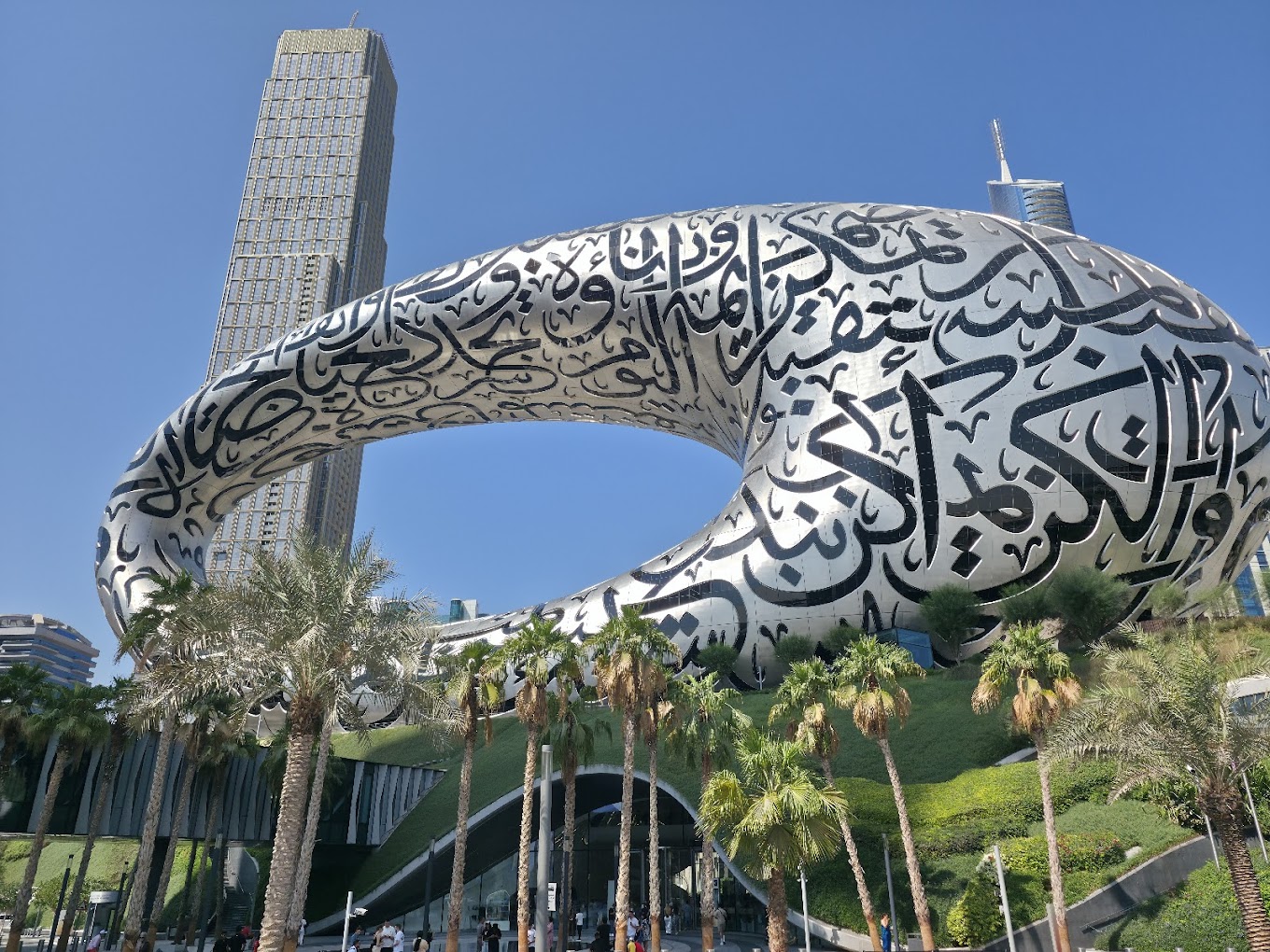
Look up. That massive silver torus floating in front of you represents one of the most ambitious architectural projects of the 21st century. The Museum of the Future took six years to build, and what you're seeing is a structure that required inventing new construction techniques just to exist. Here's what you're actually looking at: a 77-meter-tall torus with zero internal columns. The entire building is held up by 2,400 steel tubes crisscrossing each other in what engineers call a diagrid exoskeleton. Think of it as a massive three-dimensional puzzle where each piece was positioned by an algorithm that ran thousands of calculations to determine the optimal arrangement. The whole thing sits on a ring beam 20 meters in the air rather than at ground level, which means the structural loads travel through the air before reaching the foundation.
The architect behind this is Shaun Killa, a South African who moved to Dubai in 1998. When the international design competition was announced in 2015, Killa struggled with the brief for weeks. Then, working late one night at his dining table with just tracing paper and a pen, he sketched the torus shape that would win the competition. He sent a photo to a colleague via WhatsApp, who initially didn't understand the concept. That midnight sketch became the building you're standing in front of.
The symbolism runs deep. The green hill beneath represents the Earth and our connection to history. The torus represents humanity and our capacity for innovation. The void in the center represents the unknown future, what we haven't yet discovered. The design draws from Chinese feng shui principles, where circular shapes represent both the fertile fields of Earth and the limitless possibilities of imagination. The off-center void creates visual movement, suggesting that the future is always in motion, never static.
Now look at the Arabic calligraphy wrapping around the facade. That's the work of Emirati calligrapher Mattar bin Lahej, who spent four months refining it with the architects. He chose Thuluth script, one of the most majestic forms of Arabic calligraphy, specifically because it commands attention even if you don't read Arabic. The three quotes are from His Highness Sheikh Mohammed bin Rashid Al Maktoum's poetry, selected personally by him. The execution is extraordinary. Those flowing letters are formed by 10,000 individual pieces of glass, each cut by water jet machines following digital specifications. The glass is assembled into 1,024 unique composite panels, deliberately chosen to represent bytes in a kilobyte. Each panel was manufactured by robotic arms following a precise 16-step process, then 3D-scanned to verify it matched its digital twin. The recesses vary in depth up to 200 millimeters, designed to prevent water pooling while creating dramatic shadows and depth. At night, 14 kilometers of LED lights illuminate the calligraphy from within, transforming the building into a glowing statement visible across Dubai.
But the facade isn't just beautiful. Those recessed letters block external heat 66% more effectively than Dubai's building codes require, while still allowing natural light to flood the interior. It's architectural poetry also functions as advanced climate control. The project opened on February 22, 2022, deliberately chosen for the palindromic date. The journey from concept to completion involved collaboration between architects, engineers, calligraphers, and craftspeople from around the world, all working together to realize a vision that many said was impossible. On opening day, Shaun Killa visited anonymously, sitting in the reception with a coffee, watching hundreds of visitors experiencing the space. He realized then that the building had transcended its creators and now belonged to everyone who experiences it.
Listen to the audio guide: