Royal Palace - Born from Fire
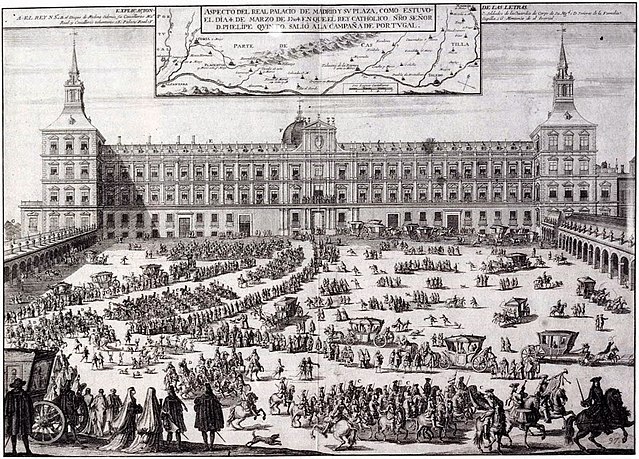
Christmas Eve 1734 should have been peaceful at the old Habsburg fortress. Instead, it became the night that accidentally created Europe's largest royal palace. The fire started in French court painter Jean Ranc's apartments—ironic, considering French artists had been decorating Spanish palaces for decades. What made this disaster particularly Spanish was the confusion: rescue bells were mistaken for Christmas mass bells, delaying emergency response while courtiers debated protocol.
The Royal Guards refused to break down locked doors without proper authorization, even as flames consumed priceless Velázquez paintings. "Las Meninas" survived only because desperate servants hurled it out of windows onto the courtyard below. By dawn, five centuries of Habsburg accumulation had turned to ash, leaving King Felipe V staring at smoking ruins and a rather expensive renovation project.
The palace visitors see today belongs entirely to Carlos III, who moved in during 1764 and promptly became Madrid's most obsessive urban planner. His devotion to city improvement masked profound personal grief—after his beloved wife Maria Amalia died in 1760, he channeled his sorrow into architectural projects with therapeutic intensity. The magnificent Gala Dining Room that still hosts state banquets replaced his deceased wife's apartments, transforming private anguish into public grandeur.
This king was so devoted to routine that courtiers could set their clocks by his activities. Every morning, his valet presented seven identical outfits—one for each day—while Carlos planned Madrid's transformation with the precision of a military campaign. He earned the nickname "el Mejor Alcalde de Madrid" (Madrid's Best Mayor) not through ceremony but through genuine urban improvement that created the city layout visitors navigate today.
Hidden within these walls lies one of music history's greatest treasures: the only complete set of Stradivarius instruments ever crafted as a matching ensemble. The Palatinos quintet—three violins, one viola, one cello—was created around 1700 by Antonio Stradivari himself. During the War of Spanish Succession, the instruments remained in Cremona's workshop until 1772, when they finally reached the Spanish court for the future Charles IV, a passionate violinist.
The quintet's story mirrors Spanish royal fortunes. During Napoleon's invasion, two pieces vanished—one recovered in 1951, but the tenor viola remains lost to history. These instruments have been played together only rarely; in January 2025, they left the palace under police escort for a rare performance, connecting three centuries of royal musical tradition.
The palace's most tragic figure was Alfonso XIII, born posthumously in 1886—literally born a king. His 1906 wedding nearly became a massacre when anarchist Mateu Morral threw a bomb concealed in a flower bouquet at the royal procession. The king and queen survived, but twenty-four people died, and Queen Victoria Eugenia's white wedding dress was splattered with her new subjects' blood—a grim baptism into Spanish royal reality.
By 1931, Alfonso had lost his throne, living in Roman exile while his palace remained empty for forty-four years. Francisco Franco declared Spain "a kingdom without a king," preserving royal symbols while excluding royalty—perhaps the most Spanish solution to political contradiction ever devised.
Today's Spanish royalty chose not to live here, transforming this palace from daily residence into ceremonial stage. The Throne Room remains exactly as Carlos III left it in 1772, while state banquets continue in halls where lonely kings once dined alone, surrounded by portraits of ancestors who'd lost empires, wives, and wars, but somehow kept building beautiful rooms for future generations to admire.
Listen to the audio guide: