Travessa das Merceeiras: The Early Excavation
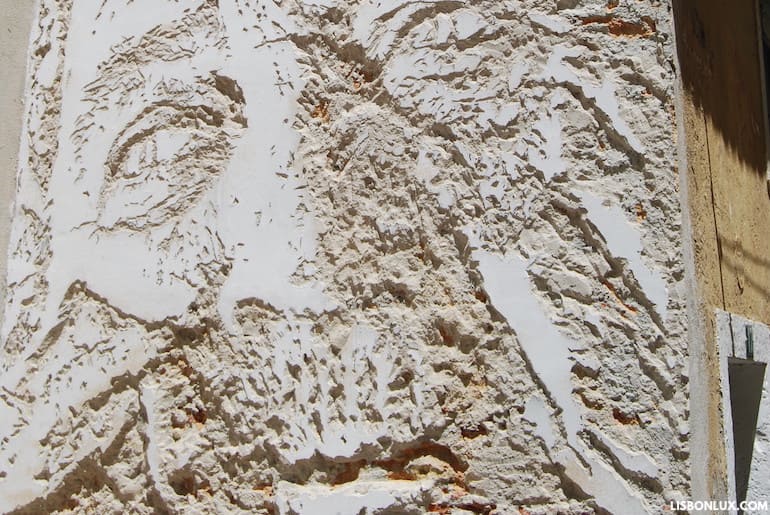
Look up. See that face carved into the cream-colored plaster? You found it. Most people walk right past.
This is one of Vhils' earliest carved portraits in Lisbon, created around 2009 when he was just 22. A few months earlier, he'd been a nobody doing illegal graffiti. Then Banksy invited him to the Cans Festival in London, his carved face appeared next to Banksy's piece on the front page of The Times, and suddenly galleries were calling.
But here he was, back in Alfama, carving anonymous faces into hidden alleyways behind the cathedral.
The person in this portrait? A former local resident. Not a politician, not a celebrity. Just someone who lived here. The Memmo Alfama Hotel commissioned it as they were converting this old building, but Vhils chose the subject. He's always been clear about this: "In this day and age of vacuous celebrities, I make an intentional choice to highlight the value of ordinary people who I view as the unsung heroes of everyday life."
Watch how the carving works. He broke the portrait into three tonal values, like a stencil, then attacked the wall with chisels, hammers, and drills. What you're seeing isn't just plaster. It's layers. Centuries of paint jobs, old advertisements, repairs after the 1755 earthquake. Every wall in Alfama is a geological record. Vhils doesn't paint over history, he excavates it.
The location matters too. This isn't on a main street. You had to seek it out, walk down a side alley, look up. That's the point. "I realized one day that I could reverse the process and start removing layers instead of adding new ones," he's said. "It was like accessing the city's recent history."
By 2009, when this face appeared, Vhils was already thinking about what would happen to it. Weather, pollution, renovations. He knew it might disappear. And he was fine with that.
Nothing lasts forever, not even carved into stone.
Listen to the audio guide: