Sophia de Mello Breyner Andresen Mural by Daniel Aim
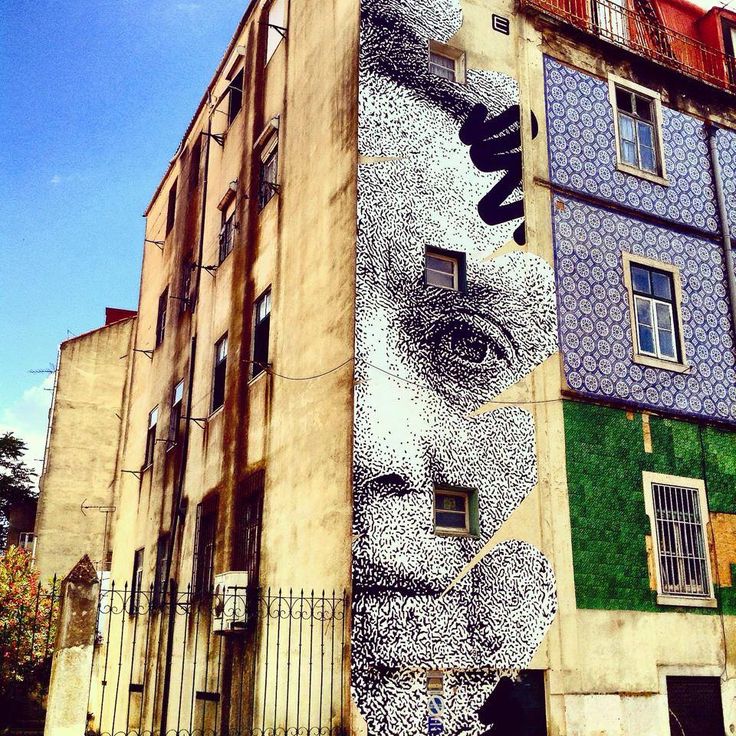
Standing before Daniel Eime's striking portrait of Sophia de Mello Breyner Andresen, you're witnessing the culmination of Lisbon's remarkable street art transformation. This sophisticated stencil work represents everything the city's urban art scene has become – technically masterful, culturally meaningful, and completely legal.
Daniel Eime brings formal training in set design to his street art, creating these intricate large-scale stencils that blur the line between illustration and urban intervention. His black-and-white aesthetic, combined with abstract elements woven into realistic portraiture, demonstrates how Portuguese street artists have developed distinctive visual languages that reference local culture while remaining internationally relevant.
Notice the technical precision required for this scale of stencil work. Unlike spray-painted murals that can be corrected and adjusted, stencil art demands exact planning and flawless execution. Each layer must align perfectly, each cut must be precise. The result is this almost photographic quality that makes Sophia's intense gaze feel present and alive on the wall. Sophia de Mello Breyner Andresen was only one of Portugal's most influential poets of the 20th century – so significant that her remains rest in the National Pantheon among Portugal's finest historical figures.
But let's rewind to understand how we got here. Lisbon's relationship with street art is like that friend who shows up late to the party but ends up owning the dance floor. While European capitals like Berlin and London were getting spray-painted in the 70s and 80s, Portugal was fashionably delayed – political graffiti appeared first, but the real explosion didn't happen until the 1990s, with Lisbon fully embracing the movement by the early 2000s.
Between 2010 and 2011, the CRONO Project brought international street art heavyweights to three abandoned buildings on Avenida Fontes Pereira de Melo – BLU, Os Gemeos, Sam3, and others. Those murals are gone now, victims of time and development, but they marked the moment when Lisbon shifted from simply tolerating graffiti to actively commissioning it. By 2008, the city had created GAU (Galeria de Arte Urbana), Portugal's first institutional framework dedicated to urban art.
The Graça district where we're standing was once plastered with unsanctioned tags and illegal pieces. By 2008, the city council had enough. Instead of just power-washing decades of expression away, they did something surprisingly clever: they created legal spaces for artists to work, transforming what was once criminalized into celebrated cultural production.
Eime's portrait of Portugal's beloved poet demonstrates this evolution perfectly. This isn't guerrilla art created under cover of darkness – it's a commissioned piece celebrating Portuguese literary heritage through contemporary urban art techniques. The technical precision of his stencil work, combined with abstract elements woven into realistic portraiture, shows how Portuguese street artists have developed sophisticated visual languages.
Why Graça? This district has special significance – traditional yet bohemian, working-class roots but increasingly trendy. The narrow streets and weathered buildings provided perfect canvases for transformation. Some of Portugal's most renowned street artists got their start here, and international heavy-hitters have left their marks as well.
Throughout our tour, you'll see how contemporary artists reference traditional Portuguese elements – incorporating tile patterns, historical figures, and cultural symbols into their work. The contrast between old and new creates dialogue between past and present that makes Lisbon's street art scene particularly fascinating.
Today we'll explore everything from delicate stencil work to massive murals carved directly into walls, political statements to environmental messages created from recycled trash. You'll discover how Portuguese artists are gaining international recognition while international artists flock to Lisbon for its welcoming attitude and year-round painting weather.
Listen to the audio guide: