Introduction: The Sugar Cathedral
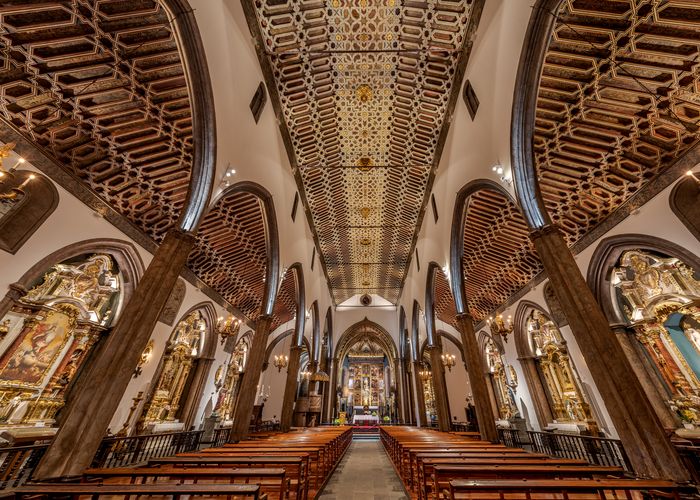
Right, so you're looking at the Sé do Funchal. Cathedral of Our Lady of the Assumption. Looks reasonably impressive for a small Atlantic island, doesn't it? Gothic portal, bell tower, solid stonework. But here's what the guidebooks won't tell you up front: for roughly 18 years in the 16th century, this building was headquarters for the largest archdiocese in the history of Christianity.
From 1533 to 1551, the archbishop nominally seated here had spiritual jurisdiction over territories stretching from Brazil to Japan, from West Africa to the Moluccas. Every baptism in Goa, every marriage in São Tomé, every funeral in Bahia, technically answered to this place. And here's the kicker: none of those archbishops ever actually visited Madeira. They ran the world's largest diocese by remote control from mainland Portugal. So right away, we're dealing with something absurd. This entire structure represents one of history's great acts of bureaucratic overreach, a spiritual empire administered from an island most Europeans couldn't find on a map.
But let's back up. Why does this cathedral exist at all? The answer is sugar. Literal sugar. By the 1490s, when construction began, Madeira was producing over 1.4 million kilograms of sugar annually. It was briefly the sugar capital of the world. And the man who commissioned this cathedral, Dom Manuel, wasn't yet king of Portugal. He was Duke of Beja and Viseu, and he owned Madeira. The site where you're standing? Used to be sugarcane fields. Manuel donated this land, called Campo do Duque, the Duke's Field, specifically for this church. So the symbolic transformation is literal: agricultural profit into sacred architecture. Sugar into stone. Commerce into cathedral.
Manuel became king in 1495, and suddenly resources really flowed. He personally funded the entire main chapel decoration. Every expense, straight from the royal household. The building was finished in 1517, consecrated in October of that year. Fifteen years of construction, funded by an economic boom that was already starting to collapse. By 1530, Madeira's sugar production would crash by 90 percent due to soil exhaustion and deforestation. But by then, the cathedral was done. And in 1533, Pope Clement VII elevated it to an archdiocese.
The title given to the first archbishop is genuinely stunning: Archbishop of Funchal, Primate of the Indies and all new lands discovered and to be discovered. Think about that phrasing. Not just discovered lands. Lands to be discovered. They were claiming spiritual authority over places that didn't exist yet on any European map. This was Manuel's vision made ecclesiastical policy. He genuinely believed God had chosen Portugal to unite the world under Christian dominion. His official title as king included Lord of the Conquest, Navigation and Commerce of Ethiopia, Arabia, Persia and India. No European monarch had ever explicitly claimed commercial rights in a royal title before.
Manuel was trying to be both a medieval crusader king and a modern commercial empire builder simultaneously. And this cathedral embodies that contradiction. It's Gothic in structure, but it incorporates mudéjar, Islamic-influenced decorative elements in the ceiling. It's funded by a cash crop economy that prefigured plantation slavery. It's decorated by Flemish masters whose paintings were purchased with sugar profits. And beneath the choir seats, as we'll see, there are satirical carvings mocking corrupt clergy, a kind of humor that would be censored a generation later during the Counter-Reformation.
Everything here encodes contradictions. That's what makes it fascinating. So as we move through, I want you to see this not as a religious monument to admire, but as a document of a very specific historical moment. A moment when a small island sat at the crossroads of emerging global trade networks. When sugar could buy masterpiece art. When an ambitious king could genuinely believe he was building the kingdom of God on Earth while running what was essentially an early capitalist enterprise. And when craftsmen could hide jokes beneath holy seats and get away with it. Let's go inside.
Listen to the audio guide: