Fifty years of collecting, eighteen years of building, one opening day.
THE PALACE AND THE COLLECTION
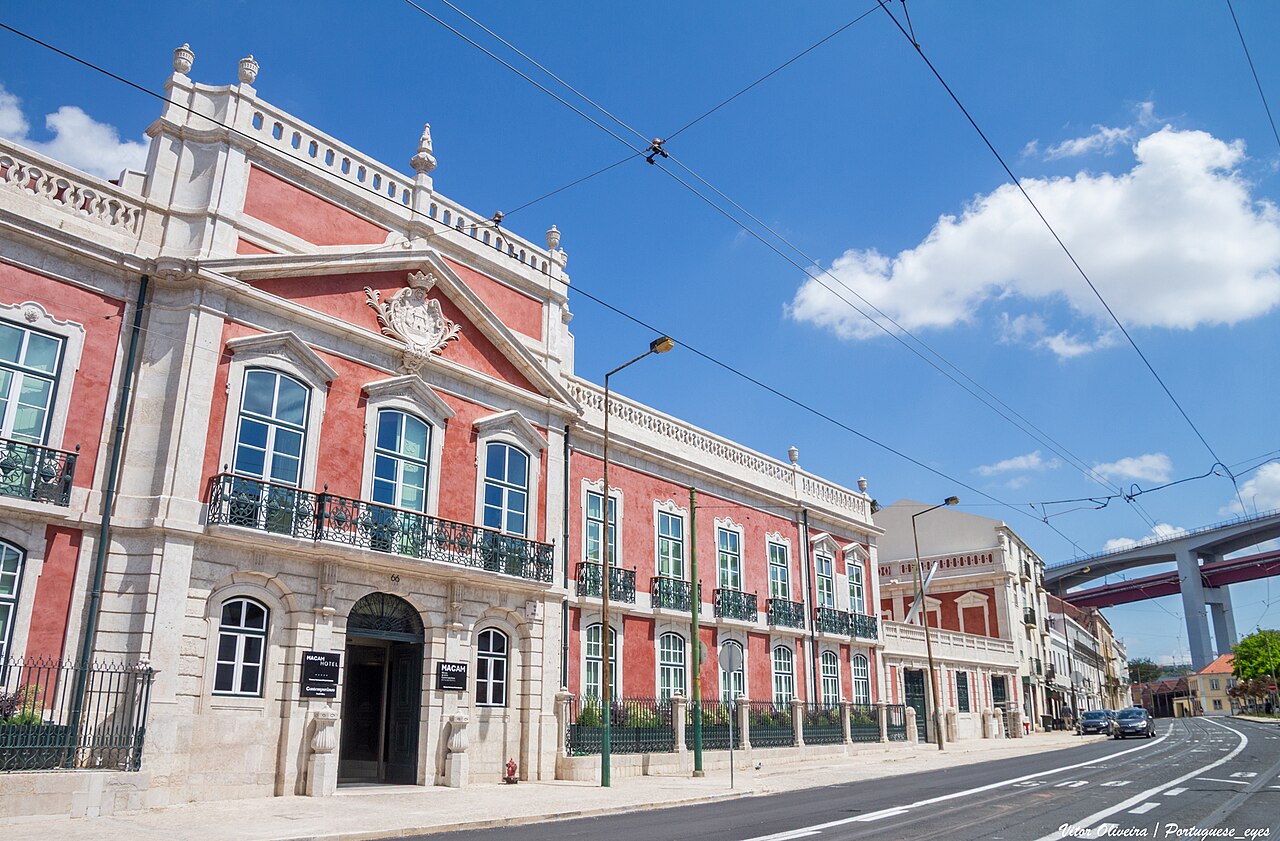
Welcome to MACAM. The building where you are standing is the Palácio dos Condes da Ribeira Grande, built in 1701, right here on Rua da Junqueira facing the Tagus. It survived the earthquake of 1755 when most of Lisbon collapsed into rubble. In the 1800s, it housed João da Câmara, a playwright who became the first Portuguese writer ever nominated for the Nobel Prize in Literature. Then it became a girls' school, the Liceu Rainha Dona Amélia, which ran through most of the 20th century. When the school closed in 2002, the building just sat here. Empty. Falling apart.
Armando Martins bought it in 2007. He's a mechanical engineer who became a property developer, and by then he'd been collecting art for over thirty years. He'd originally planned to build a purpose-built museum on public land by the river, designed by Ricardo Bofill. That concession got revoked. So he bought this palace instead and spent the next eighteen years turning it into what you're standing in now.
That new wing is clad in three-dimensional ceramic tiles by Maria Ana Vasco Costa; they won the Surface Design Awards in London in 2024. The tiles reference Portugal's azulejo tradition but use modern, environmentally friendly materials.
Now, about the man who built this. Armando Martins was born in 1949 in Penamacor, a small town in the interior. Son of a farmer. At 14 he moved to Lisbon for school. He studied engineering, lived through the 1974 revolution, spent five years in Brazil working in industrial equipment, came back and built a career in property development. His landmark project was the Atrium Saldanha building in central Lisbon; the one designed by Ricardo Bofill that won architecture prizes.
But parallel to all of that, he was collecting art. It started around 1967 with some serigraphs, then his first original painting on March 22, 1974; his 25th birthday, the day before the revolution. A work by Rogério Ribeiro that he bought on installments because he couldn't afford it outright. For the next fifty years, he kept buying. First exclusively Portuguese art. Then, from 2000 onward, international contemporary work. Over 600 pieces by more than 280 artists.
For decades, almost no one saw the collection. It sat in warehouses and private homes. Then in 2018 it won the "A" Collection Award from Fundación ARCO in Madrid, one of the most prestigious recognitions for private collections in Europe. And Martins decided it was time to share it publicly.
This museum opened on March 22, 2025; exactly 51 years after that first painting, on his 76th birthday. The whole project was funded privately, no state support, no bank loans. The model is unusual: a museum with a 64-room five-star hotel inside it, designed so the hotel revenue sustains the museum. As Martins says, this is a museum that has a hotel, not a hotel that has a museum.
MACAM stands for Museu de Arte Contemporânea Armando Martins. You're about to walk through half a century of Portuguese and international art history. Let's go inside.
Listen to the audio guide: