WHERE GOD MEETS MARITIME GLORY
Jerónimos Monastery
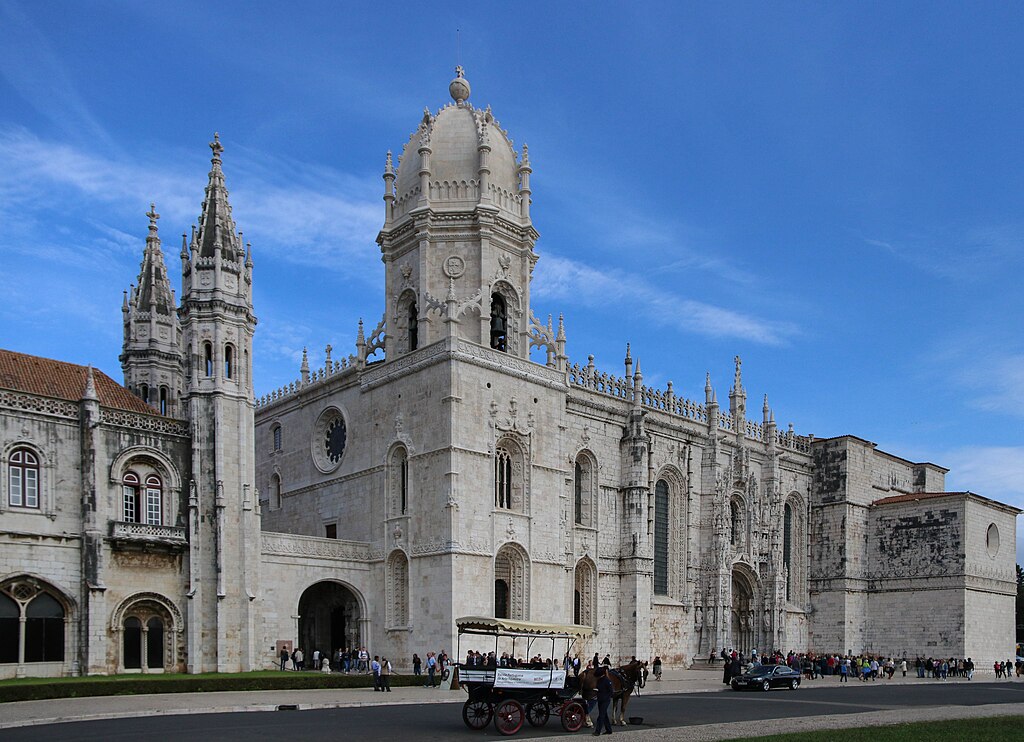
Welcome to Jerónimos Monastery, the 16th-century equivalent of a billionaire building a rocket just to prove they could. Except in this case, King Manuel I actually created something useful and aesthetically pleasing.
This wasn't just another pretty church – it was Portugal's ultimate power move. What started as a humble chapel for sailors to pray before potentially sailing off the edge of the world (or so they thought) transformed into this colossal monument when Vasco da Gama returned from India with his ships full of spices and Portugal suddenly had cash to burn.
Picture this: it's 1501, Portugal just hit the geographical jackpot by finding a sea route to India, and King Manuel I decides, "Let's commemorate this by building something so ridiculously ornate that people will be taking selfies with it five centuries later." And here we are, phones in hand, proving him absolutely right.
The monastery literally funded itself with the spoils of exploration – receiving 1/20 of all goods flowing in from India. Nothing says "we're crushing this global trade thing" quite like a monastery that pays for itself with spice money.
Originally, this area was just a small medieval village called Restelo with a tiny chapel dedicated to Our Lady of the Star – essentially a spiritual GPS for navigators. The Infante D. Henrique (Prince Henry the Navigator) expanded it, dedicating it to Our Lady of Bethlehem (Belém). Famous explorers like Vasco da Gama himself knelt here before departing, probably thinking "if this voyage doesn't work out, at least I prayed at a nice spot."
When the chapel became too small for all the sailors frantically praying before their perilous journeys, Manuel I decided to upgrade. In 1496, he got papal permission to build a monastery for Hieronymite friars (monks who followed the rule of St. Jerome and apparently had excellent taste in real estate).
The construction unfolded in two major phases: first under master Diogo Boitaca starting in 1501/1502, then from 1517 under the Castilian master João de Castilho. While the original plans included four cloisters, budget constraints – or perhaps architectural reality checks – resulted in just one being completed. Still, that single cloister turned out to be a masterpiece of stone innovation.
What makes Jerónimos so special is its Manueline style – a uniquely Portuguese architectural flex that combines Gothic structure with maritime motifs, exotic discoveries, and royal symbols. It's essentially architecture as propaganda: "Look how wealthy and worldly we are!" carved into every surface.
The monastery served its religious purpose until 1833 when Portugal, like many European countries going through their secular phase, kicked out the monks and repurposed religious buildings. Today, it houses the National Archaeology Museum and the Maritime Museum – a fitting tribute to the explorers who made this opulent monument possible through their dangerous voyages.
As you walk through, remember you're not just in a UNESCO World Heritage site (since 1983), but in the physical manifestation of when Portugal was having its best century ever. This wasn't just a place of worship – it was the Instagram humble-brag of the Renaissance world.
Listen to the audio guide: